How to Cut Home Inspection Report Time With AI
Where report time actually goes, and how to move the writing into the inspection itself so less work waits for you at home.

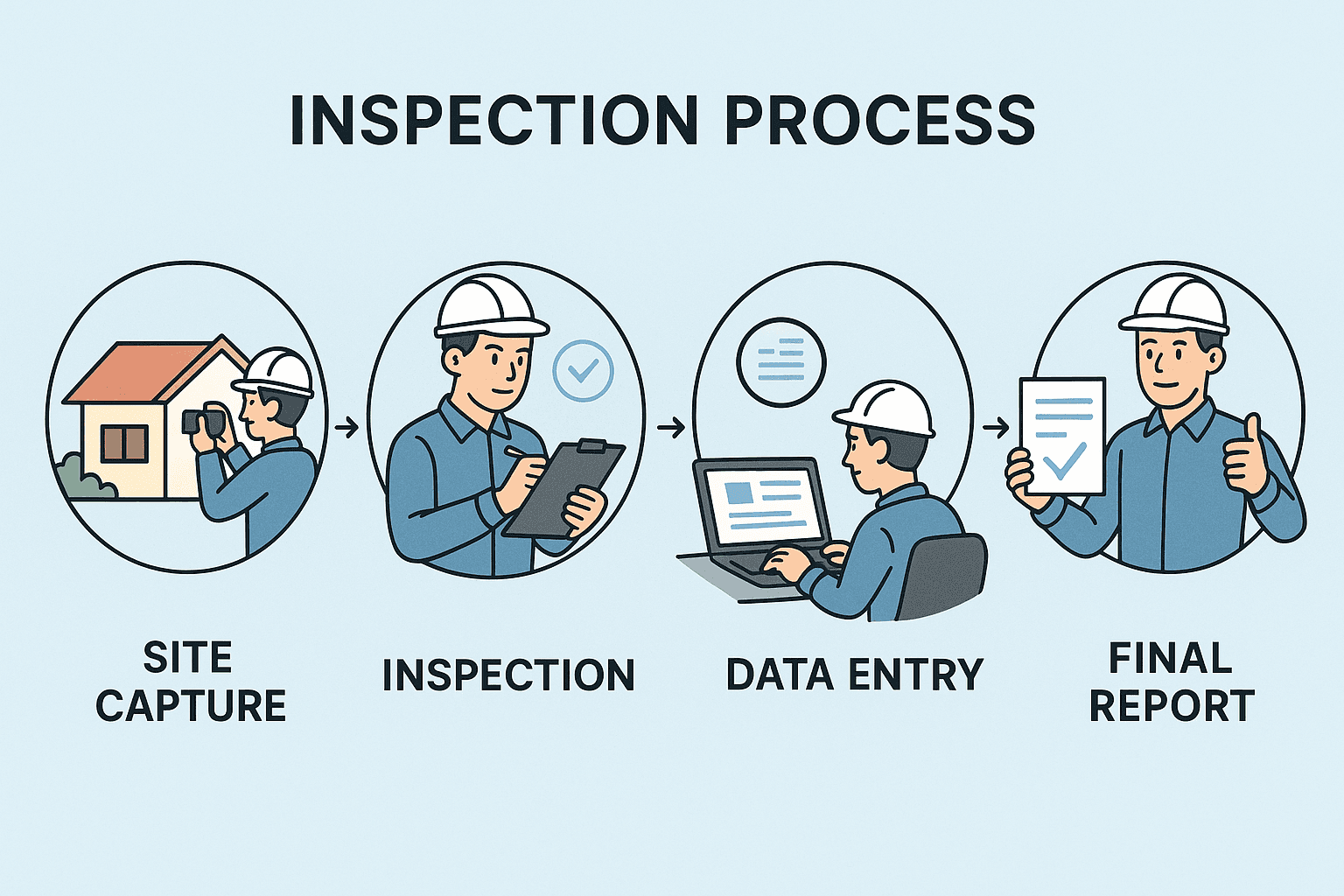
Ask a room of home inspectors what they would change about the job, and report writing comes up before pricing, before marketing, before difficult clients. It is the part that follows you home.
The inspection itself is bounded. Three hours at the property, and you are done. The report is not bounded. It expands into the evening, it competes with dinner, and it is the reason a fully booked week can still feel like it is going badly.
This is a practical guide to shrinking it. Not with a new habit or a better notepad, but by moving the work into the inspection itself.
Where the time actually goes
Before fixing anything, it helps to know what you are fixing. For most inspectors the evening breaks down into four things, and only one of them is inspecting.
Re-entering what you already know. You saw the double-tapped neutral. You understood it immediately. Then you wrote a shorthand note, and now, four hours later, you are converting that note into a sentence a buyer can act on. The knowledge was complete at the moment of observation. Everything after that is transcription.
Photo management. Finding the right image, cropping it, marking the defect, attaching it to the right line item. Multiply by sixty photos.
Comment selection. Scrolling a library to find the wording you want, then editing it for this particular house.
Assembly and delivery. Summaries, formatting, PDF generation, sending, then chasing payment.
Only the first of those requires your expertise, and it required it hours earlier. The rest is administration wearing a professional disguise.
The principle: capture, do not transcribe
Every meaningful reduction in report time comes from the same move. Capture the finding in a form the software can use, at the moment you observe it, instead of capturing a reminder that you will later expand.
A note that says "GFCI kitchen" is a reminder. It costs you two minutes tonight. Ten of those is twenty minutes.
Spoken context is capture. "Kitchen counter receptacle left of the sink, no GFCI protection, within six feet of the basin, recommend a licensed electrician install GFCI protection." That is already the comment. Nothing is left to reconstruct.
The tooling matters less than the shift. Any platform that lets you produce report-ready content on site will beat any platform that lets you produce excellent notes.
Step 1: Speak the finding, do not summarize it
Voice is the single largest lever, and most inspectors underuse it by treating it as dictation for notes rather than as the report itself.
Binsr's AI Voice Quick Add is built for the second use. You talk through what you found, including the context and the recommendation, and it turns that into structured report content rather than a transcript you clean up later.
Two habits make the difference:
Say the whole thought. Location, condition, implication, recommendation. It feels verbose out loud. It is the difference between finishing on site and finishing at 9pm.
Speak while you are looking at it. Not in the truck afterward. The detail you lose in the walk back to the driveway is exactly the detail you will spend ten minutes reconstructing.
Step 2: Let photos carry their own explanation
Photographs are evidence, but an unannotated photo of a wall makes a client squint and email you.
AI Photo Quick Add turns an image into report content, and AI Image Annotations mark up what you are pointing at, so the client sees the crack rather than the wall. AI Galleries handle organizing the images by section instead of leaving you to sort sixty files by hand.
The practical rule: photograph the defect, then immediately annotate and attach it. A photo filed in the moment costs seconds. The same photo filed in the evening costs a minute of "which bathroom was this?"
Step 3: Start from a library, not a blank field
If you are writing defect language from scratch, you are doing work that was finished years ago by someone else.
Binsr includes more than 12,000 comments and templates written by two inspectors with more than 60 years of combined field experience. Combine Comments with AI keeps the wording consistent when a single issue needs several comments merged, and AI Instructions let you set standing guidance about how your report content should read, so you are not correcting the same tone problem on every job.
If you already have a library you trust, the AI importer brings it across from your current software rather than making you rebuild it. Your language is the asset. The software should adapt to it.
Step 4: Work offline, because the defects are underground
Crawlspaces, basements, mechanical rooms, rural properties with one bar of signal. The places that generate the most report content are reliably the places with the least connectivity.
Binsr's Report Builder works offline and syncs afterward, which matters more than it sounds. A tool that silently fails to save a crawlspace photo does not cost you a photo. It costs you a return visit or a gap in your documentation.
Step 5: Deliver and invoice in the same motion
The report is not finished when it is written. It is finished when the client has it and you have been paid.
Binsr generates both digital reports and PDFs, with configurable summaries and downloadable summary PDFs, and Stripe payments are built in. Card processing is 2.9% + $0.30 and ACH is 0.8%, passed through at cost with no markup.
Sending the invoice with the report, rather than three days later, removes an entire follow-up task from your week and gets you paid while the work is still fresh in the client's mind.
What to actually measure
Track one number: minutes from leaving the property to the client having the report.
Not report-writing time, because that hides the searching, the photo sorting and the second pass. Not inspection time, because that is not where the problem is. Door to delivery.
Write down your current number for five inspections. Then change one thing, and measure five more. Most inspectors discover their bottleneck is not where they assumed. Some lose the most time to photos, some to comment editing, some to formatting and delivery. Fixing the wrong one feels like effort and changes nothing.
What AI does not do
It does not make the call. You decide what is a defect, what is safe, what needs a specialist and how urgently. That judgment is the service your client is buying, and no model should be making it.
What AI removes is the typing between your judgment and the client's understanding of it. That is worth removing. The judgment is not.
Be equally clear-eyed about a related trap: a report that is fast but vague is worse than a slow one. Speed is only valuable if the finished report is at least as clear, as specific and as defensible as what you produce today. Test that before you trust it.
Frequently asked questions
Keep reading
More on the reporting workflow in Binsr Report Builder AI, Binsr features and Binsr pricing.
Try Binsr on five real inspections. No time limit, no credit card. See pricing or start your trial.